
Today we're announcing that NeverBlink now supports ClickHouse: Cloud, self-hosted, and Kubernetes deployments alike.
It's the same AI database administrator already trusted in production by brands like Akamai, Perforce, and Palo Alto Networks, now fluent in a new engine: health checks, alerting, root-cause analysis, query analytics, schema reviews, and 24/7 access to senior ClickHouse engineers.
Adding your first cluster is free — get started here.
ClickHouse Fails Quietly
ClickHouse is fast because it defers work: merges, TTL deletes, and replication all happen in the background, eventually. That's why it can ingest millions of rows per second, and also why the worst ClickHouse incidents don't start with an alert. When the background machinery stalls, everything still looks fine, right up until it doesn't.
If you run ClickHouse in production, some of these will sound familiar:
- Merge backlog piles up. Parts accumulate faster than the merge pool clears them, and ingestion eventually fails with
TOO_MANY_PARTS. - A materialized view drops data. It fails mid-insert, the source table gets the row, the target quietly doesn't, and downstream rollups under-count for weeks. (More in ClickHouse Materialized Views Explained.)
- TTL stops keeping up. Deletes only happen inside merges, and ClickHouse deprioritizes them when the pool is busy, until a replica goes read-only.
- Replicas quietly diverge. A Keeper hiccup leaves a replica stale, and by default ClickHouse serves reads from it rather than erroring.
- Detached parts eat the disk. Broken parts land in the
detachedfolder, where ClickHouse never cleans them up, until it fills.
Nobody gets paged for any of this. ClickHouse exposes over a thousand metrics through system tables, but very few teams know which fifteen actually predict outages (more in ClickHouse Monitoring: Metrics That Matter). That's the gap NeverBlink was built to close: AI does the continuous watching and investigation, grounded in engine-specific knowledge, while your engineers stay in control of what gets applied.
What NeverBlink for ClickHouse Does
Alerts for the failures nothing else catches, with the fix attached. Purpose-built watchers for merge backlog, replication delay, stuck mutations, Keeper flapping, and Kafka consumer lag, ranked by severity and delivered via Slack, email, or PagerDuty while the problem is still a warning. Each alert arrives with the investigation done: what happened, what it's affecting, and what to do next, down to copy-paste SQL.
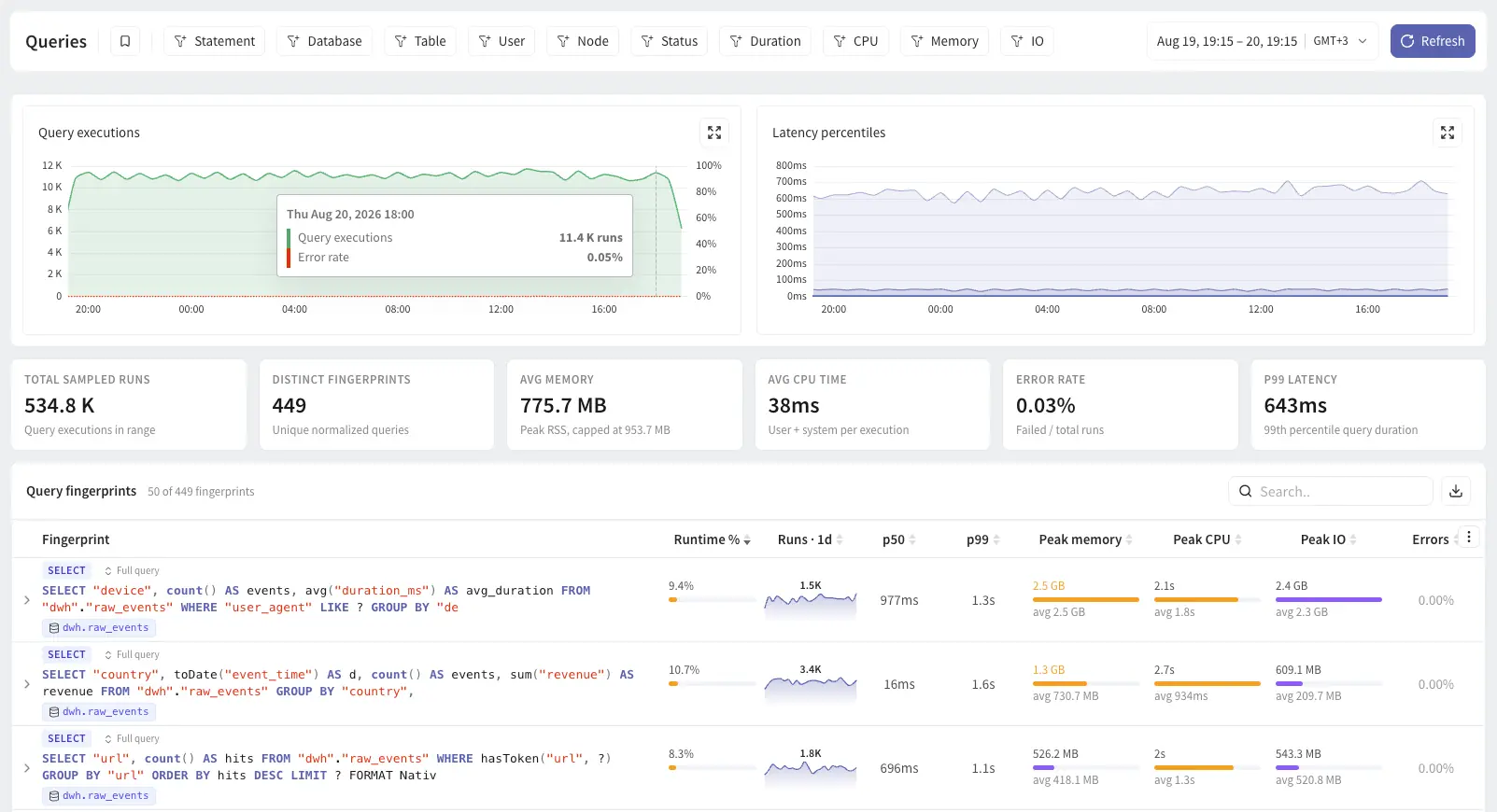
Query analytics that finds and explains slow queries. NeverBlink fingerprints every query on your cluster, surfaces the expensive ones, explains why (a full scan against the wrong ORDER BY key, a memory-hungry GROUP BY), and suggests the rewrite.
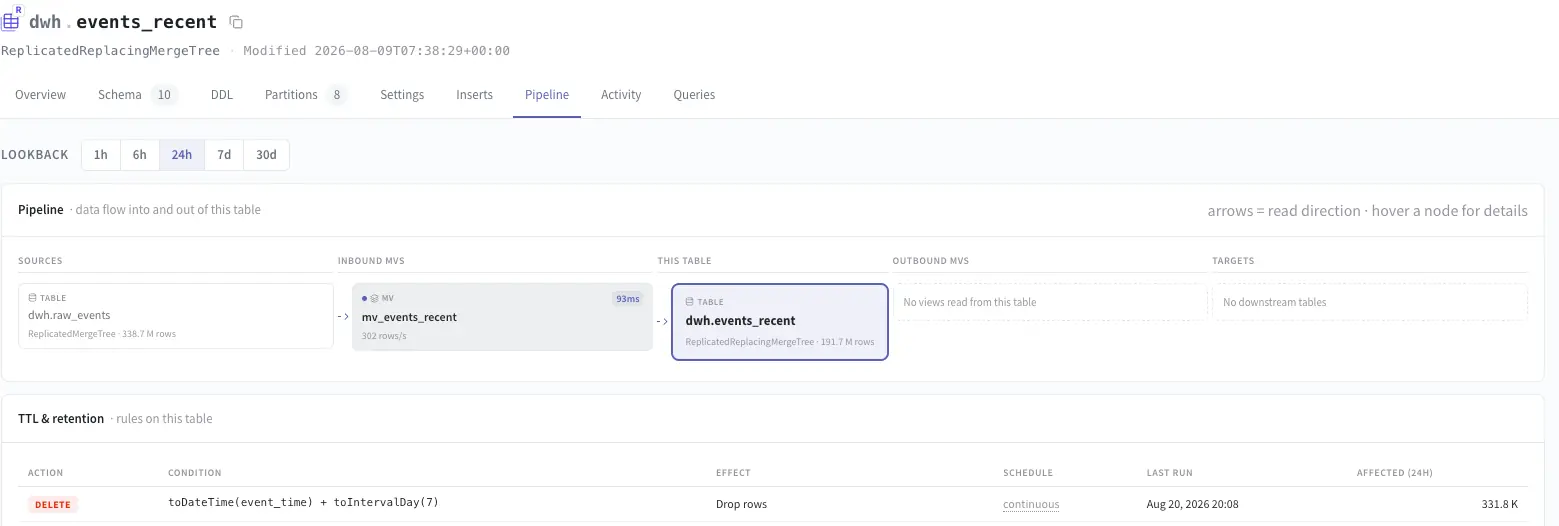
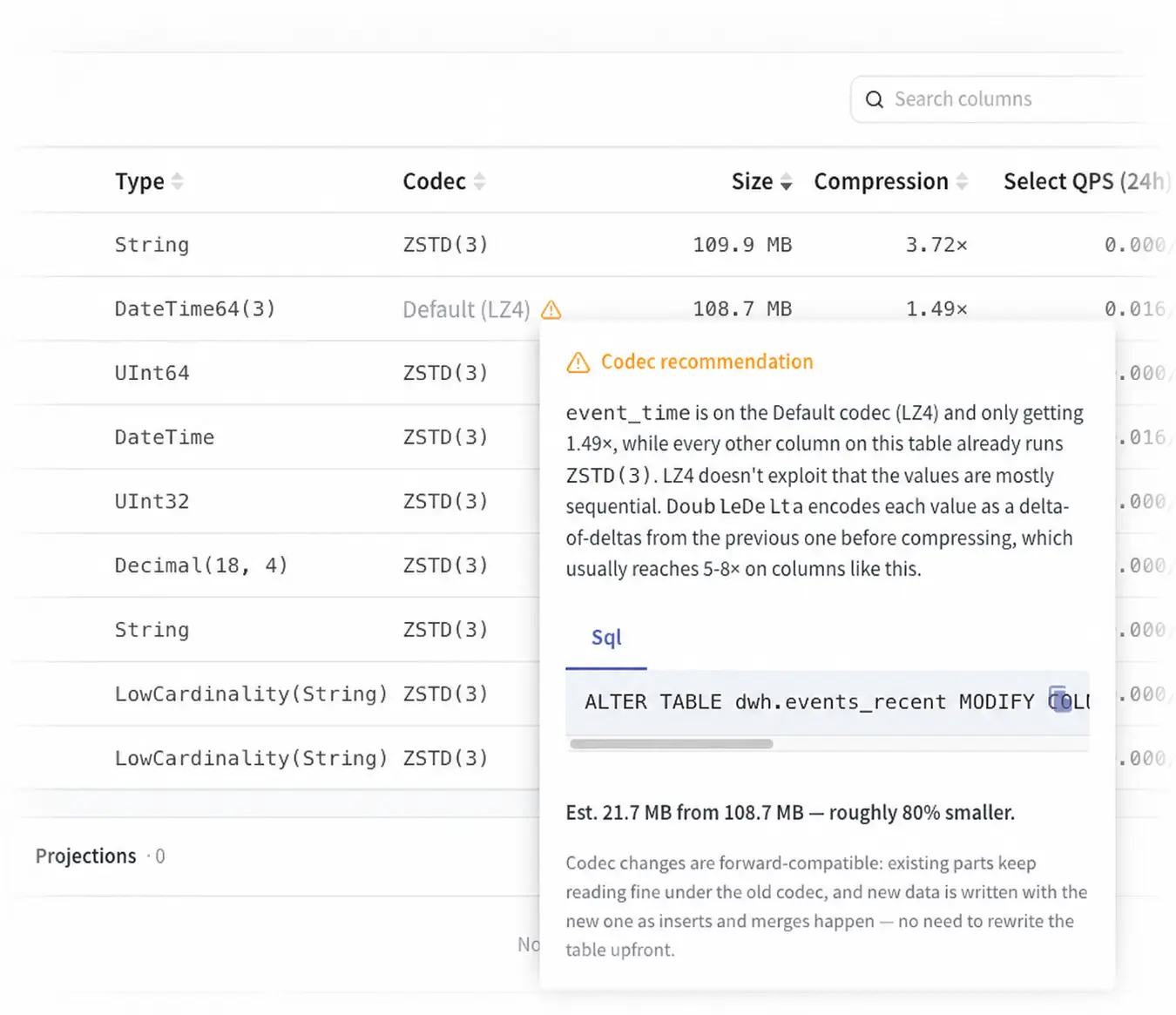
Your schema and pipelines, actually visible. NeverBlink maps how data flows from source tables through materialized view cascades to TTL and retention, and reviews every table for savings left on the table: wrong compression codecs, oversized types, partition keys fighting your queries, each with the ALTER statement and estimated gain.
A health score you can act on, with nothing installed on your database servers. Scored checks across stability, performance, resiliency, and security, re-run continuously off a lightweight collector that reads system tables only, never your data. NeverBlink is SOC 2 Type II certified and never changes your cluster on its own; premium customers get unlimited access to the BigData Boutique team behind it.
On ClickHouse Cloud? You're Covered Too
NeverBlink fully supports ClickHouse Cloud, too. A managed service solves the infrastructure piece: provisioning, upgrades, backups, uptime. But it can't save you from unoptimized application usage, and managed pricing tends to make the easy fix for that, scaling up, the costly one. That's the layer NeverBlink covers: query analytics, schema reviews, and cost recommendations on top of your managed service. ClickHouse Cloud keeps the cluster running; NeverBlink makes sure what you run on it is worth the bill.
Why ClickHouse, and Why Now
ClickHouse has become the default engine for real-time analytics, trusted by companies like Anthropic, Meta, Tesla, and Instacart: 4,000+ customers and a $15B valuation. More of the teams we work with run it next to their search and transactional databases, often powering the dashboards their customers see directly. Meanwhile, AI-assisted development is multiplying the load on the data layer faster than teams can hire for it. Databases are mission-critical, and there's no wiggle room for hallucinations, which is exactly why NeverBlink pairs engine-specific AI with humans keeping the keys.
What This Means in Practice
- Prevent downtime. The best incident is the one addressed while it's still a warning.
- Cut cluster costs. Customers report 25-30% lower database costs from query optimization and right-sizing.
- Give engineers their time back. Customers report 80-90% less time spent on database management.
- Stop depending on scarce specialists. ClickHouse experts are hard to hire and harder to retain.
Here's what Ariel, VP Eng at LinearB, had to say about running NeverBlink for ClickHouse in production:
ClickHouse serves the real-time analytics behind our customer-facing dashboards, so we need predictable low-latency performance around the clock. NeverBlink provides continuous insights on queries and node sizing, and walks us through the changes required to optimize the cluster. Our dashboard queries dropped from 8 seconds to subsecond, and the memory footprint and latency of our ClickHouse pipelines have reduced significantly. We can now focus on building a great product for our customers and not worry about our databases daily.
Get Started
NeverBlink for ClickHouse is available today. Setup takes minutes: create a monitoring user, point the collector at your cluster, and the first health assessment starts coming in the same day. If you're running ClickHouse in production, we'd love to show you what your cluster isn't telling you.