ClickHouse fails quietly.
NeverBlink catches it.
ClickHouse fails quietly.
NeverBlink catches it.
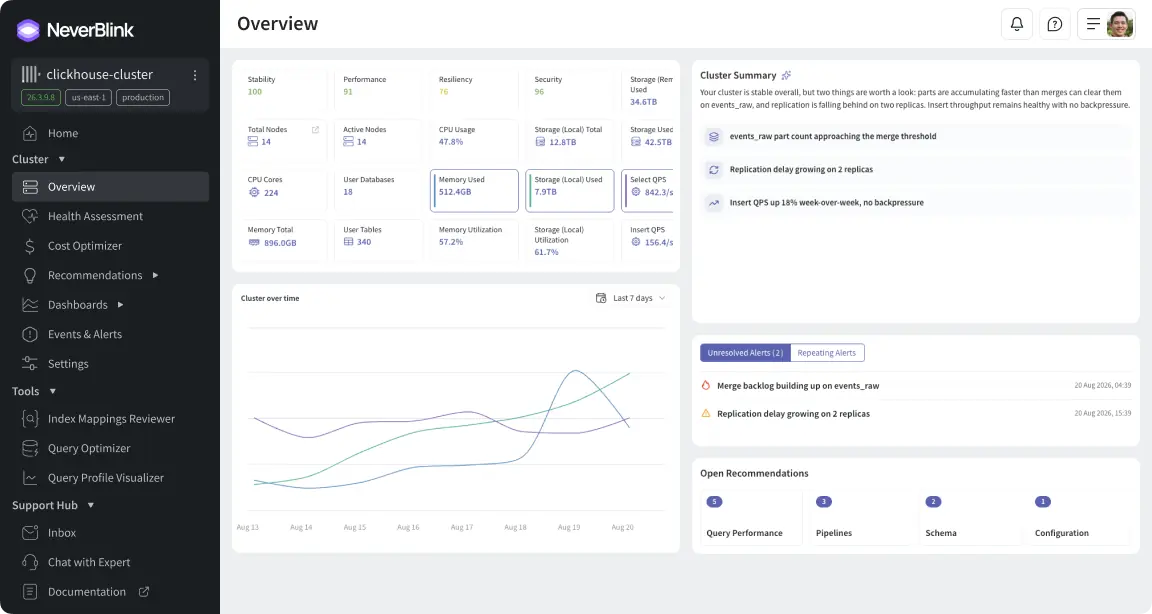
Merge backlogs, materialized views dropping data, TTLs that stop firing, replicas that quietly diverge. ClickHouse won't page you when things go wrong. NeverBlink watches your clusters around the clock, finds the problems that never show up on dashboards, and tells you exactly how to fix them.
Works with ClickHouse Cloud and self-hosted clusters. Backed by senior ClickHouse engineers on call 24/7.

Free to start · No credit card required ·
The worst ClickHouse incidents don't start with an alert
ClickHouse is fast because it defers work: merges, TTL deletes and replication all happen in the background, eventually. When that background machinery stalls, everything still looks fine. Until it doesn't.
Merge backlog piles up
Parts accumulate faster than the merge pool clears them. ClickHouse quietly throttles your inserts first, so they still succeed, just slower. Then they start failing with “Too many parts” and ingestion halts.
A materialized view drops data
When a materialized view fails mid-insert, the source table gets the data but the target quietly doesn't. Every rollup downstream under-counts, and you find the hole weeks later when someone checks against the raw data.
TTL stops keeping up
TTL deletes only happen inside merges, and ClickHouse deprioritizes TTL merges by design when the pool is busy. Retention quietly stops working, and disk usage creeps up until a replica goes read-only.
Replicas quietly diverge
A Keeper hiccup leaves a replica stale, and by default ClickHouse serves from stale replicas rather than erroring. The same query returns different numbers depending on which replica answers.
Detached parts eat the disk
Broken and unexpected parts land in the detached folder, where ClickHouse never cleans them up. They're invisible to every table metric. Then the disk fills, or too many of them block a restart.
One shard runs hot
A skewed sharding key piles writes onto one shard. Cluster averages look fine while that shard hits “Too many parts” first, and ClickHouse has no rebalancing to fix it.
Nobody gets paged for any of this. You find out weeks later, when a customer asks why the numbers don't match. This is exactly what NeverBlink watches for.
Alerts for the failures nothing else catches
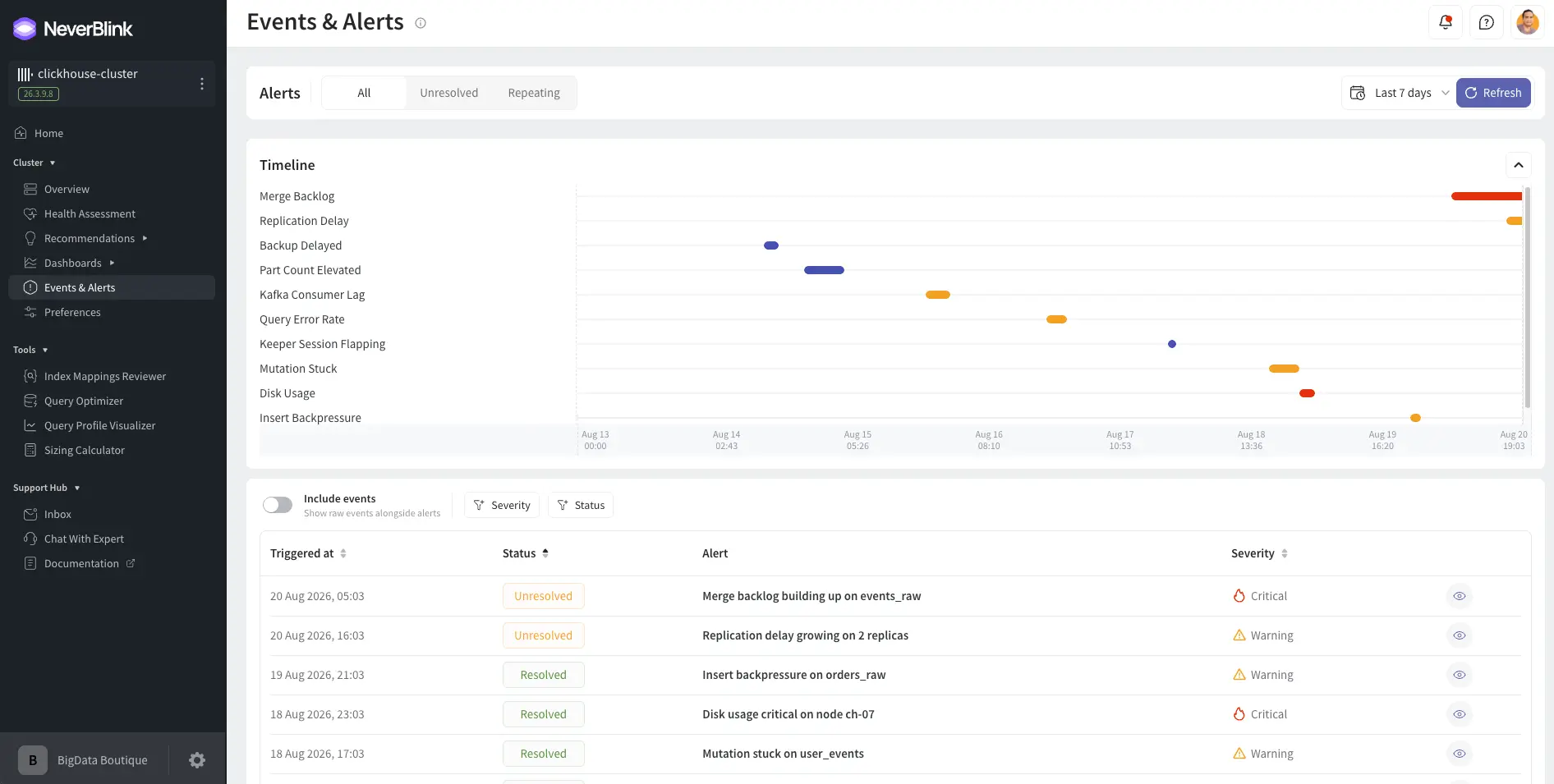
NeverBlink ships purpose-built watchers for the ways ClickHouse actually breaks: merge backlog, replication delay, stuck mutations, Keeper session flapping, insert backpressure, Kafka consumer lag. Alerts are ranked by severity and impact, and reach you via Slack, email, or PagerDuty while the problem is still a warning, not an outage.
Root-cause analysis with the fix attached
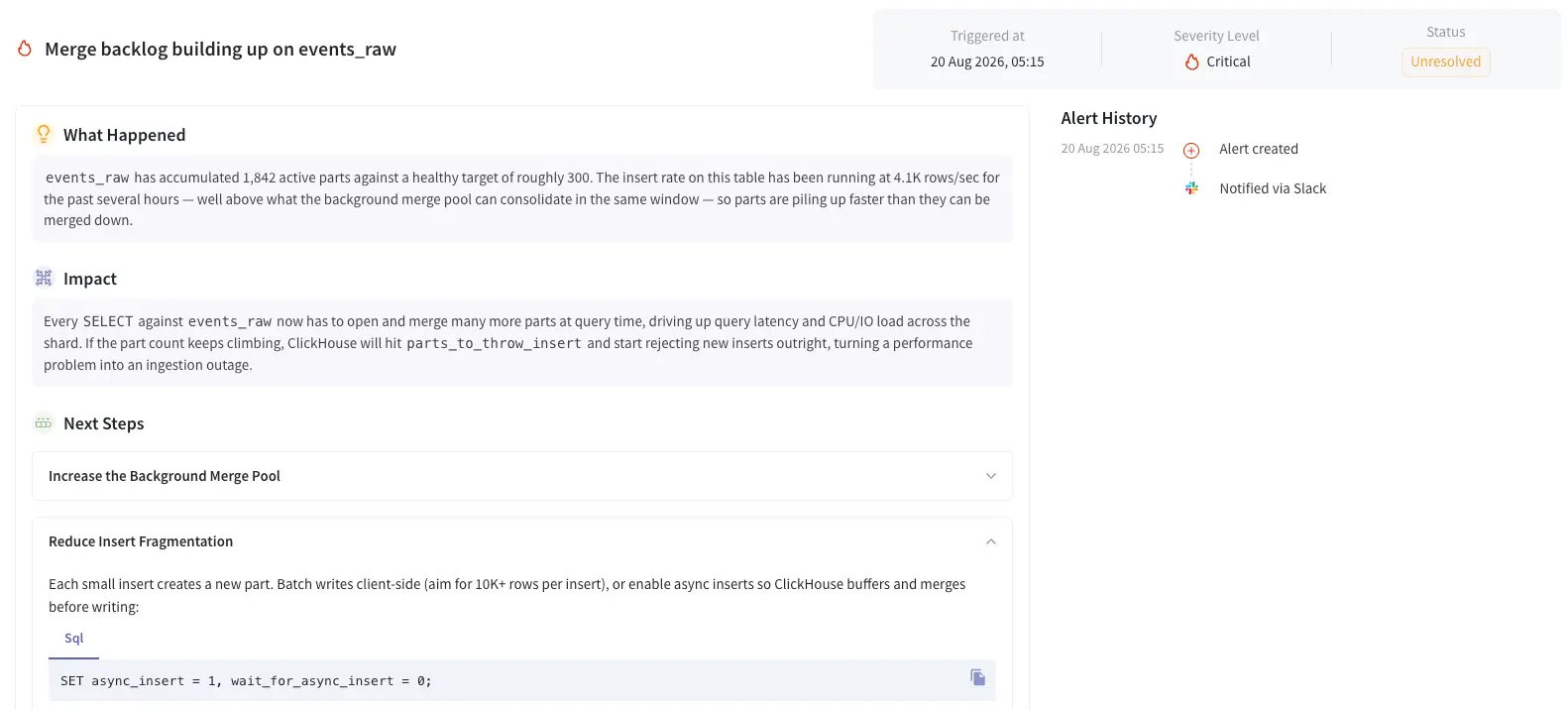
Every alert arrives with the investigation already done: what happened, what it's affecting, and what to do next, down to copy-paste SQL. When a partition hits 1,800 parts, you don't get a graph and a shrug. You get the reason, the blast radius, and two concrete ways to fix it.
Slow queries, found and explained
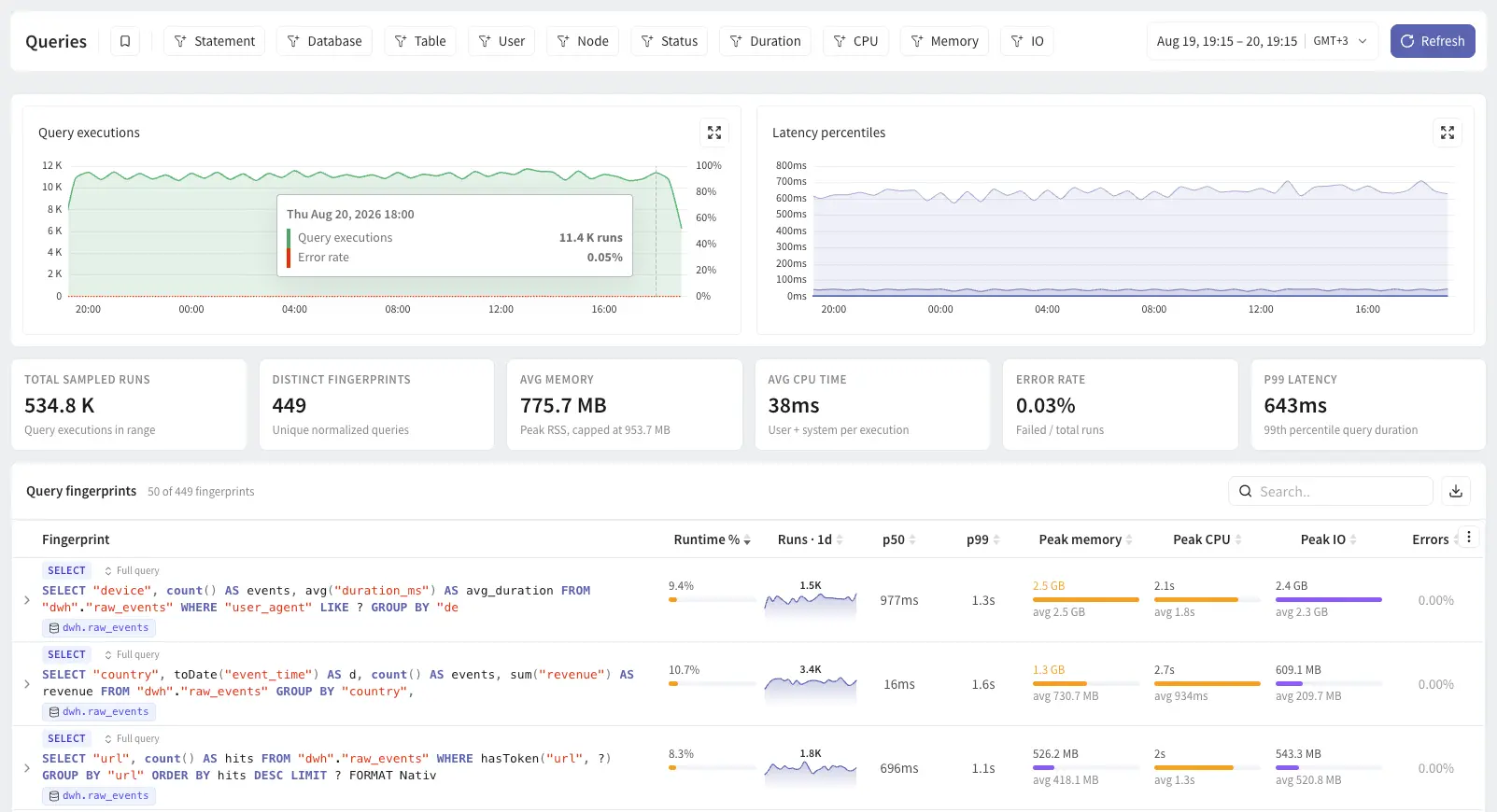
ClickHouse's query optimizer only gets you so far, so query-level tuning usually still lands on you. NeverBlink analyzes every query running on your cluster, surfaces the slow and expensive ones, and explains what's actually costing you: scans that miss the sorting key, memory-hungry aggregations, joins in the wrong order, missed opportunities for secondary indexes. Then it suggests the rewrite that fixes it.
Your schema and pipelines, actually visible
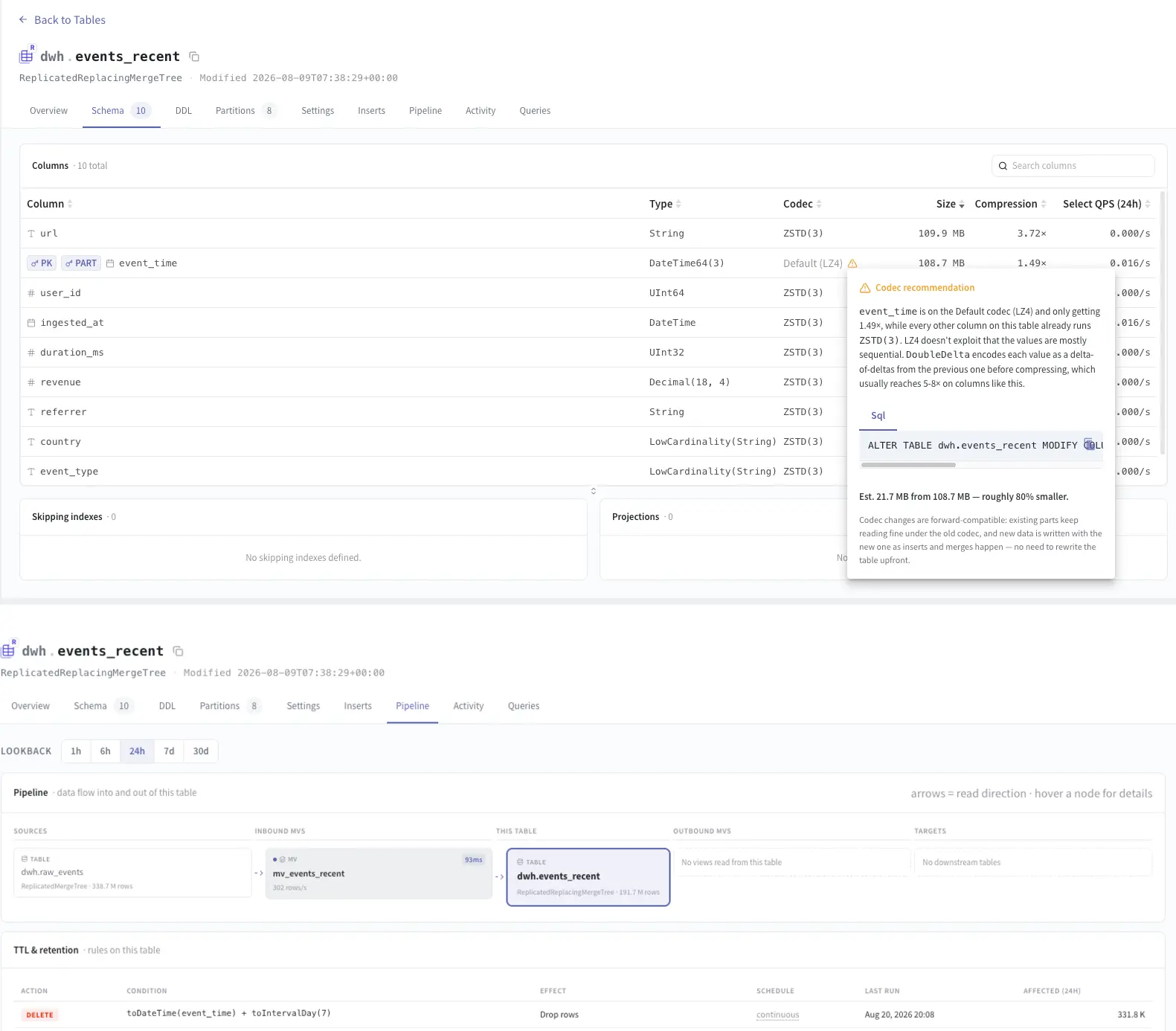
NeverBlink maps how data really flows through your cluster: source tables, materialized view cascades, TTL and retention rules. It also reviews every table for savings you're leaving behind, like wrong compression codecs, oversized types, and partition keys that fight your queries. Each recommendation comes with the ALTER statement and the estimated gain.
A health score you can act on
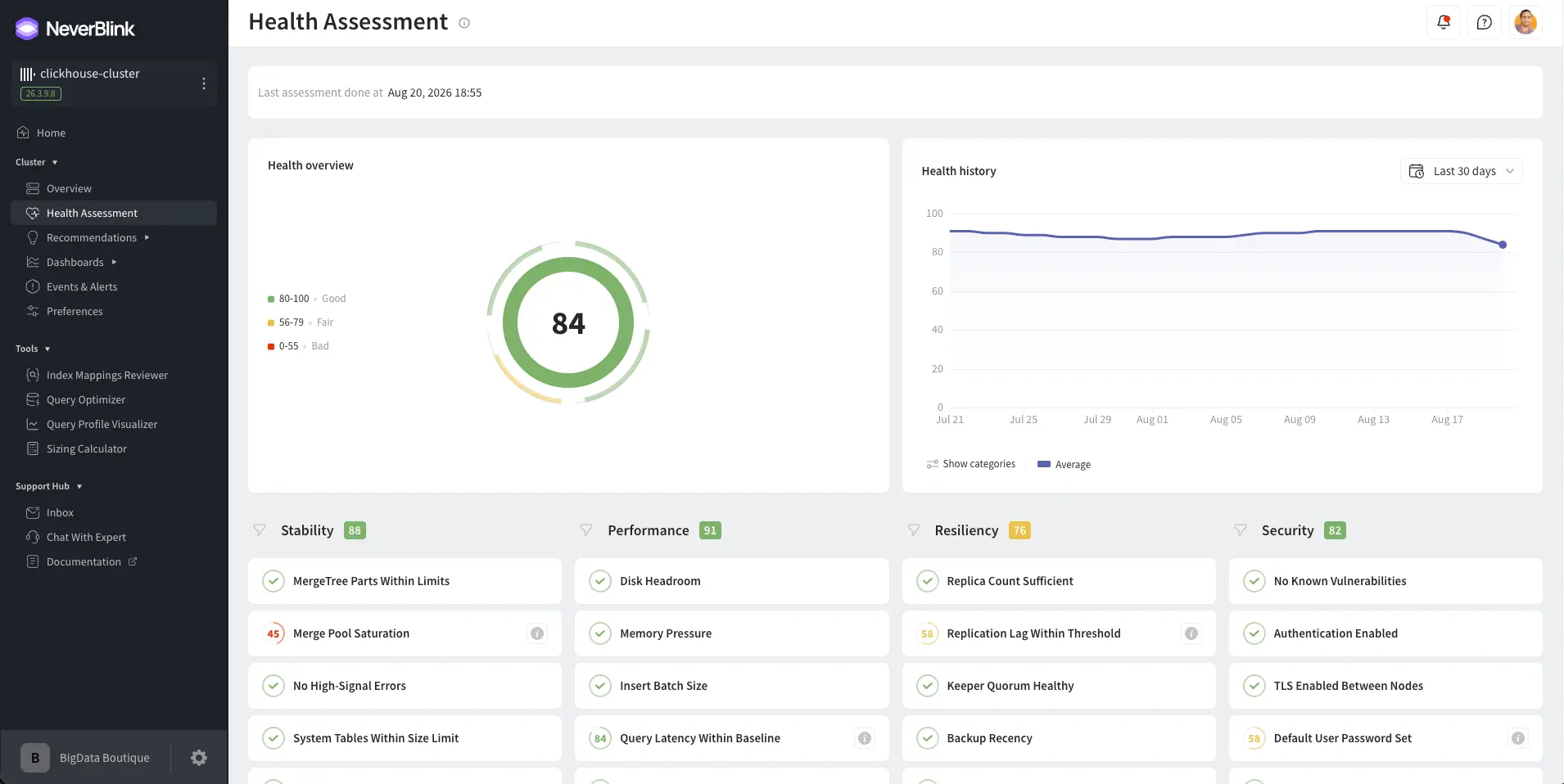
Scored checks across stability, performance, resiliency, and security, re-run continuously: parts within limits, merge pool saturation, replication lag, Keeper quorum, insert batch sizes, backup recency, TLS between nodes. Watch the score trend over time, and always know which check moved it and what to do about it.
Unlimited Developer Support
Schema reviews, query help, upgrade planning: ask our ClickHouse engineers anything, as often as you need. No ticket counting.
Enterprise Support
24/7 incident response under strict SLAs for mission-critical clusters, from engineers who run ClickHouse in production every day.
On ClickHouse Cloud? The hard parts are still yours.
A managed service takes merges, upgrades, backups, and Keeper off your plate. It doesn't design your schema, govern your materialized views, catch duplicate reads from ReplacingMergeTree, or explain your bill. NeverBlink covers what stays your problem, and works the same across ClickHouse Cloud, self-hosted, and Kubernetes operator deployments.
-

ClickHouse serves the real-time analytics behind our customer-facing dashboards, so we need predictable low-latency performance around the clock. NeverBlink gives us continuous insights on queries and node sizing and walks us through the changes needed to optimize the cluster. Our dashboard queries dropped from 8 seconds to subsecond, with memory footprint and latency reduced significantly. Now we can focus on building a great product instead of worrying about our databases.
Ariel IllouzVP of Engineering
LinearB
-
Even on ClickHouse Cloud, query performance was still our problem to solve, and we didn't always know where to start. NeverBlink points us straight at the queries that need attention and explains what to change. Our dashboards feel noticeably faster, and we spend far less time digging through system tables trying to work out why something is slow.
Piyush PatelSuccessKPI
From connected to optimized in three steps
Nothing installed on your ClickHouse servers, no rip-and-replace. NeverBlink plugs into what you already run.

1. Connect
Point NeverBlink at your cluster in minutes. A lightweight collector runs in your environment (nothing on your database servers) and reads metrics and metadata from system tables only, never your data.

2. Analyze
NeverBlink continuously inspects queries, merges, mutations, replication, schema, and configuration to surface what's wrong, what's wasteful, and what's about to break.

3. Optimize
Get specific, prioritized fixes with the why behind each one. You decide what to apply, on your schedule.
Secure, Non-Intrusive, and Dev-Friendly
NeverBlink is built to meet strict production and security requirements with zero added friction

Fast, Low-Friction Setup
With our integration wizard, it takes just a few steps and a couple of minutes to complete the NeverBlink setup.

Secure & Non-Intrusive by Design
The low-signature NeverBlink Agent runs in your environment. Nothing is installed on the cluster itself.

We Never Send Your Data
NeverBlink reads metrics and metadata only. Your actual data never leaves your environment.

Enterprise-Grade Security
NeverBlink is SOC 2 Type II certified, with independently verified controls designed to meet strict production and compliance requirements.
Frequently asked questions
Does NeverBlink replace Grafana or my system-table dashboards?
No, keep the dashboards you have. NeverBlink complements them: dashboards show you metrics, and NeverBlink adds detection, root-cause analysis, and concrete recommendations for the ClickHouse-specific problems raw graphs don't explain, like merge pressure, stuck mutations, replication drift, and schema and codec choices.
Does it work with ClickHouse Cloud?
Yes. NeverBlink supports ClickHouse Cloud, self-hosted clusters, and Kubernetes operator deployments. On ClickHouse Cloud it focuses on what the managed service doesn't cover: query and schema design, materialized view governance, deduplication correctness, and cost.
Can NeverBlink see my data?
No. A lightweight collector runs in your environment (nothing is installed on your ClickHouse servers) and it reads metrics and metadata from system tables only. Your actual data never leaves your environment. NeverBlink is SOC 2 Type II certified.
Does NeverBlink change my cluster automatically?
No. NeverBlink investigates, diagnoses, and recommends, with the reasoning behind every recommendation and usually the exact SQL. Your team decides what to apply and when, so consequential changes always stay under human control.
How long does setup take?
Minutes. Create a monitoring user, point the collector at your cluster, and the first health assessment and query analytics start coming in the same day. Most teams see their first actionable findings within the hour.
Find out what your ClickHouse isn’t telling you.
Try NeverBlink Free